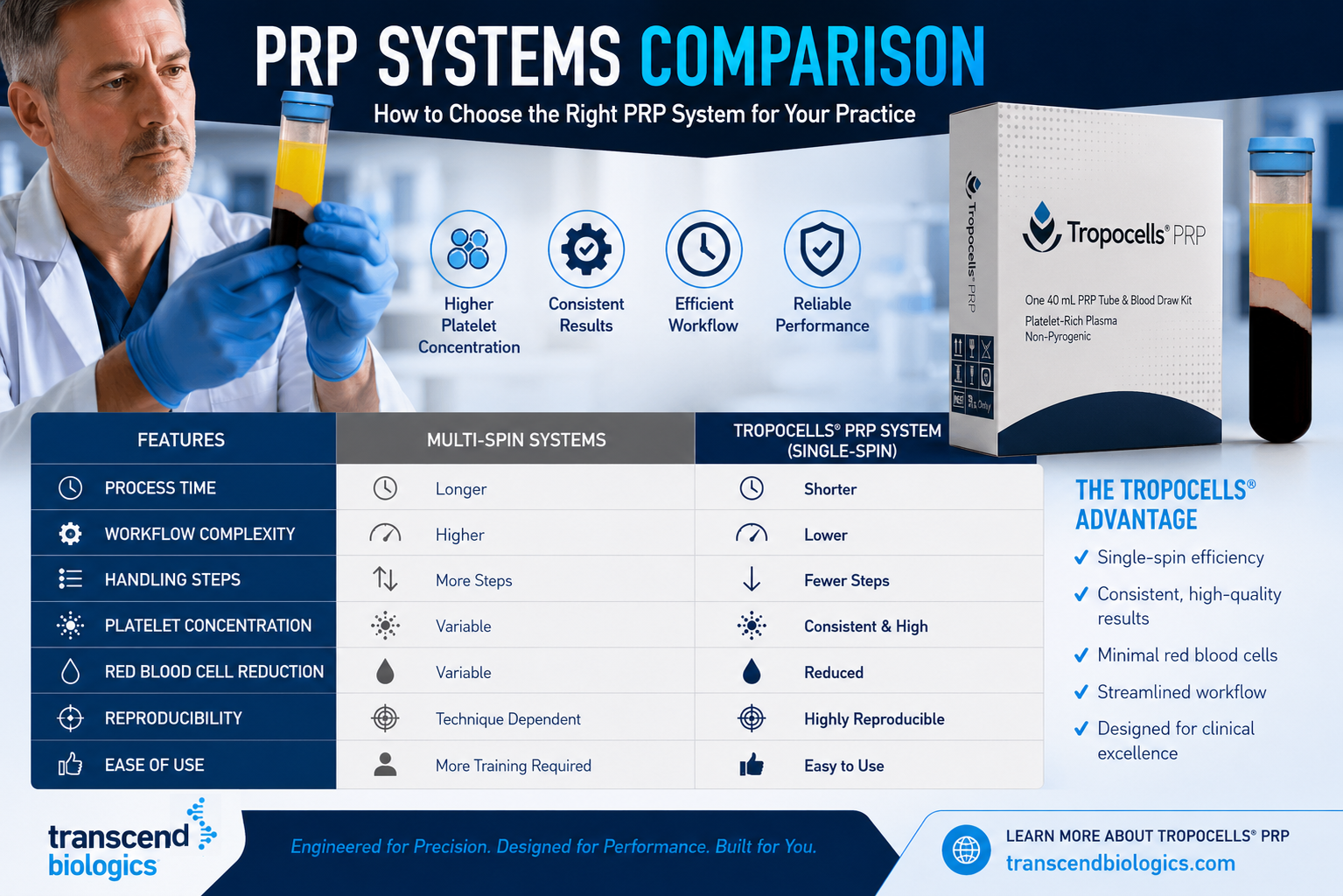
Introduction: Single-Spin vs Dual-Spin PRP Methods
Single-spin vs dual-spin PRP preparation is an important topic for physicians evaluating platelet-rich plasma systems. Today, practices compare preparation methods to improve efficiency, simplify training, and support consistent workflows. As a result, understanding the differences between these approaches can help clinicians make informed decisions.
What Is Platelet-Rich Plasma (PRP)?
Platelet-rich plasma (PRP) is an autologous biologic preparation derived from a patient’s own blood. First, clinicians collect blood and place it into a centrifuge. Next, the system separates blood components and concentrates platelets.
The process typically includes:
- Blood collection
- Centrifugation
- Component separation
- Platelet concentration
Because platelets contain signaling proteins involved in the body’s natural response to injury, researchers continue to study PRP across many medical specialties.
For an overview of regenerative medicine research, visit the National Library of Medicine:
https://pubmed.ncbi.nlm.nih.gov/
Single-Spin vs Dual-Spin PRP Preparation
Different systems use different centrifugation methods. Therefore, physicians often compare workflow requirements before choosing a platform.
Single-Spin PRP Preparation
Single-spin PRP systems use one centrifugation cycle. Consequently, the preparation process involves fewer steps.
Physicians may value single-spin systems because they offer:
- Simple workflows
- Shorter preparation times
- Less staff training
- Easy integration into daily practice
Furthermore, streamlined procedures can help busy clinics maintain efficiency.
Dual-Spin PRP Preparation
Dual-spin PRP systems use two centrifugation cycles. As a result, the process includes additional handling steps.
When reviewing dual-spin systems, physicians commonly consider:
- Preparation time
- Staff involvement
- Workflow complexity
- Consistency requirements
However, protocols differ among manufacturers, so outputs may vary from one system to another.
Comparing PRP Preparation Methods
When evaluating systems, physicians usually review several factors instead of focusing on one feature.
Workflow Efficiency in Single-Spin vs Dual-Spin PRP
Workflow often plays a major role in system selection. For example, practices with higher patient volumes may prefer systems that fit easily into daily schedules.
In addition, shorter preparation procedures may reduce staff burden.
Training Requirements for PRP Systems
Training needs vary between systems. Therefore, physicians frequently consider how quickly staff members can learn and perform the preparation process.
Likewise, practices often value systems that are easy to teach and repeat.
Reproducibility and Consistency
Consistency from one procedure to the next is another important factor. Consequently, physicians review manufacturer protocols and instructions before selecting a platform.
Moreover, repeatable workflows can help practices maintain standard procedures.
Practice Integration
PRP systems should fit naturally into existing clinical routines. Because of this, many physicians evaluate:
- Equipment requirements
- Procedure times
- Staffing needs
- Office workflow
As a result, system design becomes an important consideration.
Why Many Physicians Prefer Simple Workflows
Not all systems are designed the same. Therefore, practices often compare:
- Platelet concentration
- Cellular composition
- Preparation time
- Workflow efficiency
- Ease of use
In addition, physicians may consider ongoing support and staff training.
Single-Spin vs Dual-Spin PRP and Tropocells® PRP
Tropocells® PRP uses a single-spin preparation process designed for point-of-care use.
Consequently, practices may benefit from:
- Simplified preparation
- Efficient workflows
- Straightforward staff training
- Easy integration into existing operations
Ultimately, physicians determine which system best aligns with their clinical and business goals.
To learn more about Tropocells® PRP, visit:
https://transcendbiologics.com/tropocells-prp/
Making an Informed Decision
Choosing a PRP platform involves several considerations. First, physicians review workflow requirements. Next, they compare preparation methods and training needs. In addition, many practices evaluate support and long-term goals.
Because every clinic is different, the ideal solution varies from one practice to another.
Conclusion
Single-spin vs dual-spin PRP preparation remains an important consideration when evaluating platelet-rich plasma systems.
To summarize:
- Preparation methods differ among systems.
- Workflow efficiency matters.
- Training requirements vary.
- Practice integration is important.
- Simplicity and consistency are common priorities.
Therefore, understanding these differences can help physicians select a platform that supports their needs and fits smoothly into daily operations.
Related Resources
Internal Links
- PRP Systems Comparison:
https://transcendbiologics.com/prp-systems-comparison/ - What Is PRP?
https://transcendbiologics.com/what-is-prp/ - Tropocells® PRP:
https://transcendbiologics.com/tropocells-prp/
External References
- PubMed:
https://pubmed.ncbi.nlm.nih.gov/ - U.S. Food and Drug Administration:
https://www.fda.gov/medical-devices
Regulatory Notice
PRP preparation systems are intended for the preparation of autologous platelet-rich plasma. Clinical applications and outcomes are determined by the treating provider. Statements regarding PRP reflect published scientific literature and are not intended to imply FDA-cleared indications for specific clinical outcomes.