How PRP Preparation Technique Affects Clinical Outcomes: What Physicians Need to Know
PRP preparation technique is one of the most overlooked variables in platelet-rich plasma procedures. Physicians often focus on patient selection and injection protocols, but how a practice prepares PRP can strongly shape the final product. Therefore, every practice offering PRP services benefits from understanding how preparation technique affects quality.
Furthermore, as more PRP systems enter the market, clinicians need a solid grasp of the core variables involved. This post explains those variables, shows how they interact, and gives physicians a clear framework for choosing a PRP system.
Important Notice
FDA guidelines regulate platelet-rich plasma (PRP) as a same-day surgical procedure. A physician draws blood from the patient and returns the prepared PRP to that same patient in a single visit. This post targets licensed healthcare professionals and serves an educational purpose only. It does not offer medical advice, recommend any treatment, or claim clinical benefit for any condition. Each physician must apply independent clinical judgment and stay current with all applicable FDA regulations and guidance documents.
What Is PRP and How Does the FDA Classify It?
Platelet-rich plasma is a blood-derived preparation that a physician makes from the patient’s own blood. The process concentrates platelets above the level found in whole blood. Because the physician draws and returns the preparation to the same patient in one surgical visit, the FDA currently exempts PRP from registration under the same-day surgical procedure rule in 21 CFR Part 1271.
As a result, the FDA regulates PRP systems used at the point of care as medical devices. Physicians must confirm that any system in their practice holds 510(k) clearance or an equal regulatory status. In addition, FDA guidelines on device promotion govern all marketing claims about PRP’s clinical effects.
👉 Review FDA guidance on human cells, tissues, and cellular products: FDA 21 CFR Part 1271
Key Variables That Shape PRP Preparation Technique
Centrifugation Parameters
Centrifugation separates platelets from other blood components. Spin speed (RPM), duration, and number of cycles all affect how the components settle inside the collection tube.
Higher speeds and longer spin times improve separation but can also activate platelets too early or cause physical damage. Therefore, each system uses a specific centrifugation protocol to balance separation quality with platelet health.
Anticoagulant Selection
The anticoagulant choice also shapes the final preparation. Citrate-based anticoagulants work well because they bind calcium and stop the clotting process during handling. Additionally, the ratio of anticoagulant to blood volume affects how well platelets function after preparation.
Tube and Collection System Design
Tube shape, internal coatings, and separation barrier materials all interact with blood during centrifugation. As a result, two systems running the same spin protocol can produce very different preparations simply because of tube design.
Operator Technique and PRP Preparation Extraction
The extraction step introduces the most operator-driven variation in PRP preparation technique. In open systems, the person performing the procedure controls how well the plasma layer separates and transfers. In contrast, closed or semi-automated systems lock in the extraction process and cut operator-driven variation significantly.
👉 For foundational information on platelet biology: Platelet Physiology – StatPearls, NCBI
Three Core Metrics for Evaluating PRP Preparation Technique
Three composition metrics appear most often in the clinical literature when physicians evaluate PRP preparation quality.
Platelet Concentration Factor
The platelet concentration factor measures how much the process raises platelet count above the patient’s baseline whole blood level. A 5x factor, for example, means the prepared PRP holds five times the platelets found in the patient’s native blood. However, a higher number does not always produce better results. Researchers still debate the ideal target concentration for each application.
Leukocyte Profile and PRP Preparation Method
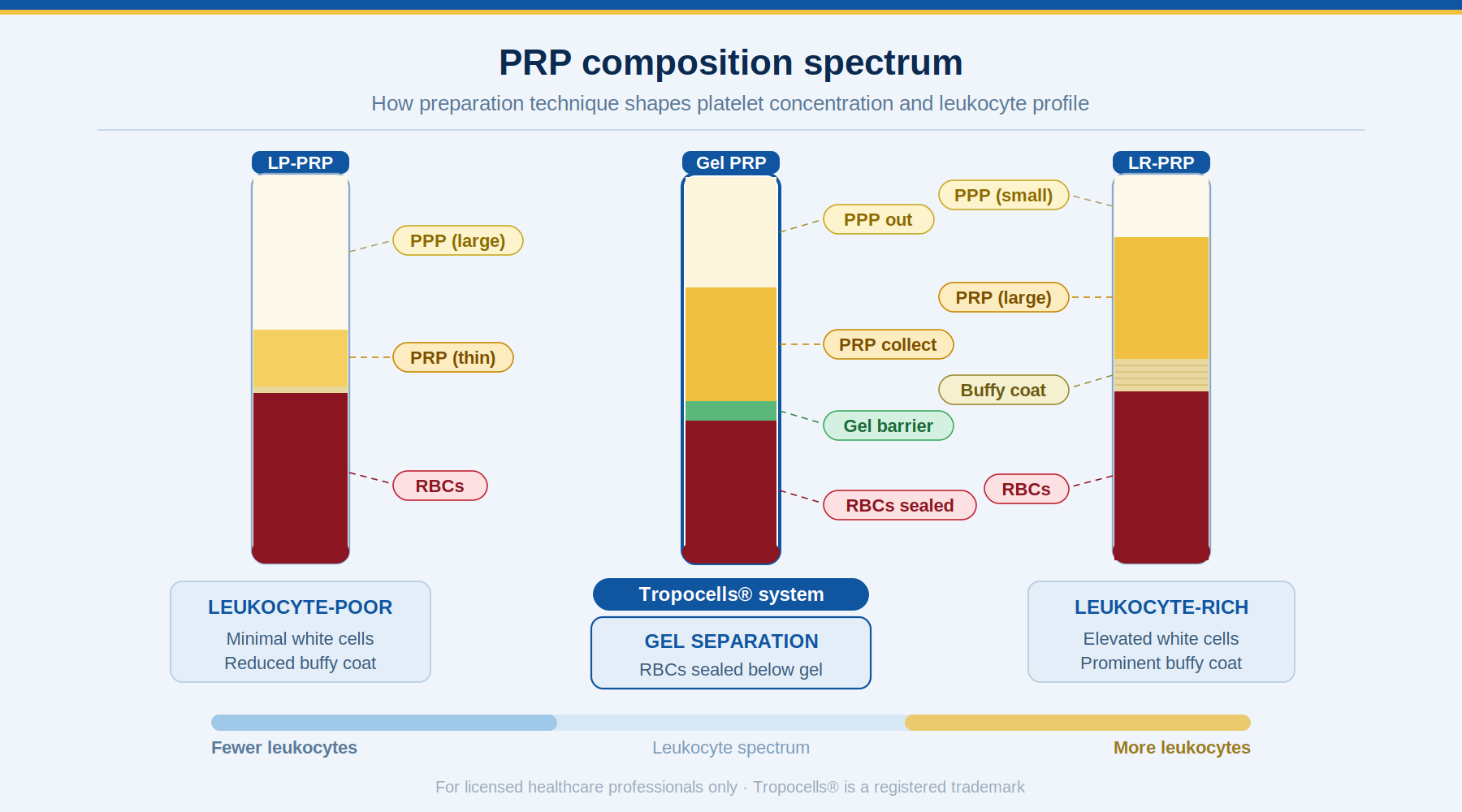
Physicians classify PRP as leukocyte-rich (LR-PRP) or leukocyte-poor (LP-PRP) based on white blood cell content. A further category, pure platelet-rich plasma (P-PRP), aims to keep both leukocytes and red blood cells low. Researchers continue to study what leukocyte levels mean for clinical results, so each physician should weigh the available evidence and use their own judgment when choosing a preparation type.
👉 Read more about leukocyte profiles: Leukocyte-Rich vs. Leukocyte-Poor PRP – Transcend Biologics
Red Blood Cell Contamination in PRP Preparation
Red blood cell (RBC) contamination weakens PRP quality. When RBCs break down, they release free hemoglobin into the preparation, which can affect local tissue. Therefore, physicians generally prefer systems that keep RBC levels low and deliver a cleaner final product.
How PRP Preparation Technique Differs: Single-Spin vs. Multi-Spin
PRP preparation technique splits into two main groups — single-spin and multi-spin protocols — each with clear workflow and composition differences.
| Single-Spin Protocols | Multi-Spin Protocols |
|---|---|
| One centrifugation cycle | Two or more spin cycles |
| Faster preparation time | Higher concentration potential |
| Fewer handling steps | Longer preparation time |
| Fewer variation points | Greater technique sensitivity |
| Fits easily into busy workflows | Higher operator training demands |
Single-spin systems suit practices with high procedure volume or smaller teams because they need less time and fewer steps. Multi-spin protocols can reach higher platelet counts, but every extra handling step adds a new point where results can vary. Strong operator training and strict protocol follow-through matter most in multi-spin workflows.
Reproducibility: The Underrated Metric in PRP Preparation Technique
Beyond concentration and composition, reproducibility may be the most useful real-world metric when comparing PRP preparation techniques. A system that delivers highly concentrated PRP but varies widely between batches creates a different clinical problem than one that reliably hits moderate concentrations every time.
Specifically, reproducibility matters for three reasons:
- Consistency across procedures — patients who return for multiple treatments get preparations with predictable traits each time
- Training efficiency — staff learn one clear protocol rather than adapting to shifting outputs
- Practice documentation — consistent preparation makes procedural records more accurate and defensible
Furthermore, closed and semi-closed systems with built-in separation mechanisms tend to beat open manual systems on reproducibility because they remove the human element from the extraction step.
FDA Compliance in PRP Clinical Practice
Physicians who offer PRP services must stay current on the rules that govern both the systems they use and how they discuss PRP with patients.
Device Clearance
Every PRP system a practice uses at the point of care needs 510(k) clearance as a medical device. Physicians should check clearance status directly with the manufacturer and confirm that the intended use matches the cleared indication.
Off-Label Use and Communication
The FDA sets rules for how physicians and companies promote medical devices. Physicians and staff must not make clinical benefit claims that go beyond what cleared labeling or peer-reviewed evidence supports. All patient-facing materials need a compliance review before use.
Same-Day Procedure Requirements
The FDA currently exempts PRP from HCT/P registration under 21 CFR 1271.15(b) when a physician prepares and uses it in a same-day surgical procedure, keeps it minimally handled, and uses it for a like purpose. Physicians should work with legal or regulatory counsel to confirm they meet current FDA guidance, which continues to evolve.
👉 Additional regulatory context: FDA Guidance on Minimal Manipulation (PDF)
Matching PRP Preparation Technique to Practice Workflow
PRP preparation technique lives inside a clinical workflow, not in isolation. Therefore, a practice must consider how each preparation step fits into appointment scheduling, staff duties, and room turnover time when choosing a system.
Key Factors to Evaluate in Your PRP Preparation Method
- Total preparation time — from blood draw to injection-ready product
- Required equipment — centrifuge specs and ancillary supplies
- Staff training demands — protocol complexity and number of steps
- Real-world consistency — how the system performs when staff changes or procedures run less often
Practices should also ask whether a manufacturer has tested system performance under real clinical conditions, not just in a controlled lab setting.
Where Tropocells® PRP Fits in This Framework
The Tropocells® PRP system tackles several of the preparation variables discussed above. Its single-spin PRP preparation technique cuts preparation time and reduces handling steps. The gel-based separation mechanism holds RBC levels low and keeps platelet layer isolation consistent from one procedure to the next.
- ✓Single-spin protocol for fast, simple workflow integration
- ✓Gel-based separation that cuts operator-driven variation
- ✓Gel barrier seals RBCs away from the final PRP product
- ✓Repeatable results across different staff members and sessions
Clinical Checklist: Evaluating Any PRP Preparation Technique
Use the framework below when reviewing any PRP system for your practice.
| Category | What to Check |
|---|---|
| Regulatory & Safety | 510(k) clearance confirmed Closed or semi-closed system design Sterility and safety documentation from manufacturer |
| Composition Data | Platelet concentration factor data on file Leukocyte profile type (LR-PRP vs. LP-PRP) RBC reduction performance data |
| Workflow & Consistency | Prep time fits your schedule Protocol suits your staff’s skill level Results stay consistent across operators and batches |
| Support & Training | Manufacturer offers a training program Technical support is easy to reach IFU and protocol docs are clear and complete |
Conclusion
PRP preparation technique shapes the composition, consistency, and clinical usefulness of the final product. Physicians who understand centrifugation, leukocyte profiles, RBC control, and batch-to-batch consistency can choose systems and protocols that fit their clinical goals.
FDA compliance also deserves attention at every step. Confirming device clearance, staying within supported indications, and meeting same-day procedure rules all protect patients and the practice.
In short, the best PRP preparation technique for any practice is the one that delivers a well-defined product every time, fits cleanly into the clinical workflow, and supports clear, compliant patient care.
👉 Explore the full Transcend Biologics PRP resource library: transcendbiologics.com
This content targets licensed healthcare professionals. It serves an educational purpose only and does not offer medical advice, a diagnosis, or a treatment plan. Qualified clinicians should perform all platelet-rich plasma procedures in line with current standards of care and applicable regulations. Individual patient results vary. No clinical outcomes are guaranteed. Tropocells® is a registered trademark of Transcend Biologics.