Published: November 18, 2026
Introduction
PRP and anticoagulants come up together more often than many practices expect. As the patient population ages, a growing share of people who ask about platelet-rich plasma also take a blood thinner, a daily aspirin, or an over-the-counter anti-inflammatory. Consequently, clinicians need a clear way to think about two separate questions: how these medications may affect the PRP sample itself, and how they may affect bleeding risk at the injection site.
This post walks through what the current literature says about each question. In addition, it offers a practical checklist that practices can adapt to their own protocols. However, it does not replace clinical judgment or the guidance of a patient’s prescribing physician.
How PRP and Anticoagulants Interact: Two Different Questions
First, it helps to separate the medication classes. Antiplatelet agents, such as aspirin and P2Y12 inhibitors like clopidogrel, act directly on platelet function. Nonsteroidal anti-inflammatory drugs (NSAIDs) also inhibit cyclooxygenase, which reduces thromboxane production in platelets. By contrast, anticoagulants such as warfarin and the direct oral anticoagulants (DOACs) act on the clotting cascade rather than on the platelet itself.
This distinction matters because PRP depends on platelets that can activate and release their granule contents. Therefore, drugs that blunt platelet activation raise a sample-quality question, while drugs that act on clotting factors mainly raise a procedural bleeding question. Of course, some patients take medications from both groups.
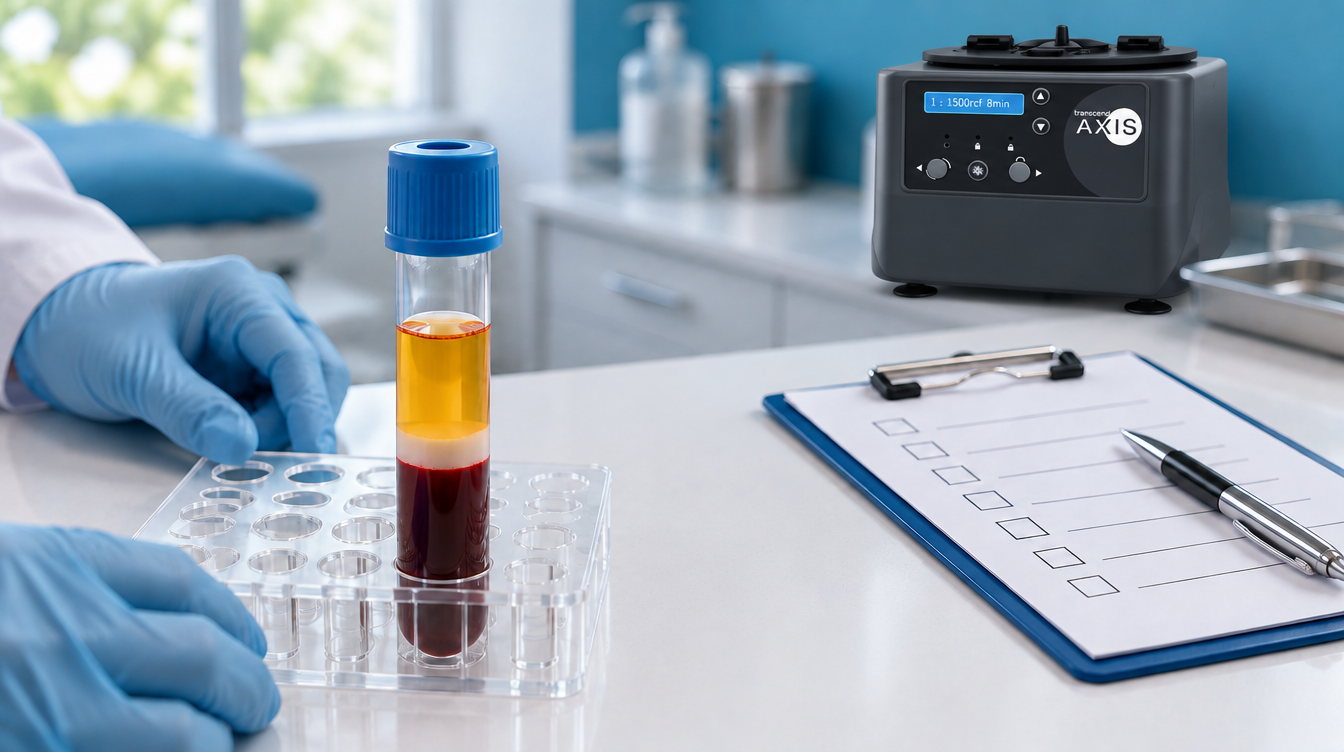
The word “anticoagulant” also appears in a second place in the PRP workflow. Most PRP preparation systems add an anticoagulant, typically a citrate-based solution, to the collection tube so the blood stays fluid before centrifugation. That in-tube anticoagulant is a routine part of preparation, and it differs from a patient’s systemic medication.
What the Research Shows About PRP and Anticoagulants
Antiplatelet Effects on the PRP Sample
Several laboratory studies have examined how common medications influence the platelets in a PRP preparation. In a 2015 pilot study, Schippinger and colleagues compared PRP from 11 patients taking NSAIDs after orthopaedic surgery with PRP from 10 healthy controls. Arachidonic acid–induced platelet aggregation dropped markedly in the NSAID group, while platelet counts stayed similar between groups. Based on these findings, the authors suggested giving NSAIDs after blood collection rather than before.
Similarly, a 2019 study in the American Journal of Sports Medicine followed 12 healthy men before and after 14 days of 81 mg daily aspirin. Low-dose aspirin did not change platelet or leukocyte counts in leukocyte-rich PRP. Nevertheless, it significantly reduced growth factor release when the researchers activated the PRP with arachidonic acid. Thrombin activation largely offset that reduction for VEGF and TGF-β1, although PDGF-AB release still declined partially. The authors noted that clinical studies still need to confirm these effects in patients.
Taken together, these studies suggest that platelet count alone may not tell the whole story. In other words, a sample can contain a normal number of platelets that respond less fully to certain activation pathways.
Anticoagulants and Injection-Site Bleeding
On the procedural side, the evidence for peripheral injections offers some reassurance. Conway and colleagues reviewed joint and soft tissue injections in patients on warfarin. They compared 32 procedures with warfarin withheld against 32 procedures with warfarin continued at a therapeutic INR. Neither group had clinical hemarthrosis or other complications. As a result, the authors concluded that continuing anticoagulation did not appear to increase complication risk for these procedures.
Spine and other deep procedures, however, sit in a different category. The American Society of Regional Anesthesia and Pain Medicine (ASRA) publishes guidelines for interventional spine and pain procedures in patients on antiplatelet and anticoagulant medications. These guidelines group procedures by bleeding risk and give medication-specific recommendations for each tier. For this reason, clinicians who perform PRP near the spine or in other high-risk locations should review them closely.
Keep in mind that most of this evidence comes from small studies or from procedures other than PRP. Consequently, practices should treat it as a starting point for protocol design rather than as definitive guidance.
Evaluating Patients on Blood Thinners: A Practical Checklist
Before scheduling PRP, many practices find it useful to build a medication review into intake. A consistent approach to PRP and anticoagulants also makes documentation easier across providers. The following checklist can help structure that conversation:
- Document every medication. Include over-the-counter NSAIDs, daily aspirin, and supplements such as fish oil or ginkgo that patients may not mention unprompted.
- Identify the drug class. Note whether each agent is an antiplatelet, an NSAID, a vitamin K antagonist, or a DOAC.
- Coordinate with the prescribing physician. Any change to an anticoagulant or antiplatelet regimen belongs in that conversation. Patients should never stop a cardiovascular medication on their own.
- Weigh procedural bleeding risk. Consider the injection site, needle depth, and proximity to neuraxial structures.
- Review elective NSAID timing. The Schippinger data support scheduling elective NSAIDs after the blood draw when clinically appropriate.
- Check your activation protocol. Activation method may influence growth factor release in patients who take aspirin.
- Record the medication history. Note it in the procedure record to support consistent documentation.
Where Tropocells® PRP Fits
Tropocells® PRP gives clinicians a standardized system for preparing autologous PRP at the point of care. Because a consistent preparation process removes one source of variability, practices can focus their attention on patient-specific factors such as medication history. To learn more about how PRP preparation works, read our guide to platelet-rich plasma for clinicians. Practices building out PRP services may also find our post on PRP insurance and coding helpful.
Conclusion: Navigating PRP and Anticoagulants
Ultimately, PRP and anticoagulants call for attention to two separate questions: sample quality and procedural safety. Current laboratory data suggest that NSAIDs and aspirin can blunt certain platelet activation pathways. Meanwhile, limited clinical data suggest that peripheral injections in patients on warfarin carry a low complication rate. Deeper and spinal procedures, on the other hand, call for a more conservative, guideline-driven approach. Above all, any decision about a patient’s anticoagulant or antiplatelet therapy belongs in a coordinated discussion with the prescribing physician.
Disclaimer: This article is for educational purposes only and does not constitute medical advice. Tropocells® PRP is a medical device for the preparation of autologous platelet-rich plasma. FDA clearance and indications vary by device; clinicians should consult product labeling for cleared indications. Some applications of PRP discussed in the literature may fall outside a device’s cleared indications. The FDA has not evaluated the statements in this article. Treatment decisions remain the responsibility of the treating practitioner.