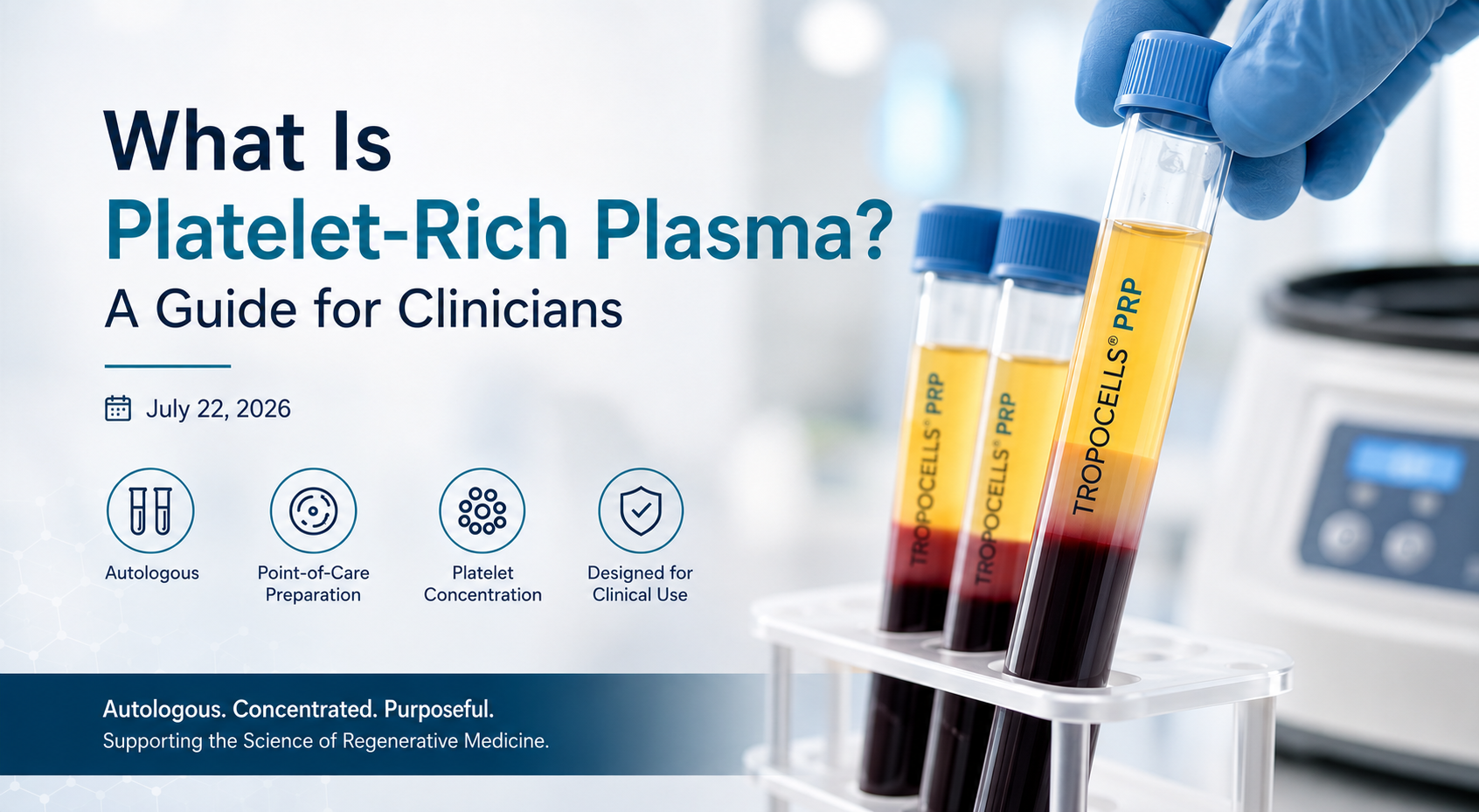
What Is Platelet-Rich Plasma? A Guide for Clinicians
Publish date: July 22, 2026
Introduction: Why PRP Understanding Matters
Platelet-rich plasma, or PRP, is a point-of-care preparation derived from a patient’s own blood. Because it is autologous, PRP has drawn steady clinical interest across orthopedics, sports medicine, and aesthetics. However, before adopting PRP into practice, physicians benefit from understanding exactly what it is and how it is prepared.
This guide covers the fundamentals of platelet-rich plasma, including how it is separated, what varies between preparations, and what clinicians should evaluate before choosing a system.
What Is Platelet-Rich Plasma?
Platelet-rich plasma is plasma that has been concentrated to contain a higher platelet count than baseline whole blood. In other words, PRP is created by isolating and concentrating platelets from a patient’s own blood sample, typically through centrifugation.
Because platelets contain growth factors and signaling proteins, researchers have studied their role in tissue repair processes. Consequently, PRP has become a focus of ongoing clinical research across multiple specialties.
Learn more about system design: PRP preparation systems
How Is PRP Prepared?
PRP preparation generally follows a few core steps. First, a blood sample is drawn from the patient. Next, the sample is processed—usually via centrifugation—to separate its components by density. Finally, the platelet-concentrated layer is isolated for use.
Along the way, several variables can influence the final preparation:
- spin protocol (single-spin vs. multi-spin)
- platelet concentration achieved
- leukocyte content
- red blood cell carryover
- total preparation time
Because these variables differ across systems, no two PRP preparations are necessarily identical—even when drawn from the same patient.
What the Research Says
Platelet biology has been studied extensively in the context of tissue repair. For a deeper look at platelet structure and function, see Platelet Physiology, NCBI.
Additionally, researchers continue to study how variables like leukocyte concentration may relate to outcomes across different applications. Peer-reviewed literature, such as studies indexed on PubMed, offers a useful starting point for clinicians who want to review the evidence directly.
Key Factors Clinicians Should Evaluate
Before incorporating PRP into practice, most clinicians review a consistent set of factors:
- Clinical factors: platelet concentration, leukocyte profile, reproducibility
- Operational factors: preparation time, workflow complexity, staff training needs
- Practice factors: patient demand, cost per procedure, integration into existing services
Because these factors interact, evaluating a PRP system in isolation—without considering practice workflow—rarely tells the full story.
Where Tropocells® PRP Fits
The Tropocells® PRP system was designed around a single-spin workflow intended to support consistent, repeatable preparation at the point of care. Because the process involves fewer steps than multi-spin alternatives, it is designed to reduce handling variability between operators.
Explore the system in more detail: Tropocells® PRP
Conclusion
Understanding what platelet-rich plasma is—and how preparation method affects the final product—gives clinicians a stronger foundation for evaluating whether and how to incorporate PRP into their practice. As with any point-of-care technology, the right choice ultimately depends on aligning system characteristics with clinical goals and practice workflow.
This content is provided for educational purposes only and does not constitute medical advice. Platelet-rich plasma preparation devices are subject to applicable FDA regulations; consult current regulatory guidance and product labeling for intended use information.