Why Platelet Dosing (Not Just “PRP”) Should Drive Your System Purchase Decision
Have you evaluated more than one PRP system? If so, you’ve probably noticed something frustrating. Every manufacturer calls their platelet-rich plasma “concentrated,” “pure,” and “optimized.” Almost none of them tell you the actual PRP platelet dosing their system delivers. Fewer still tell you how consistently it delivers that dose, or who controls the separation from draw to draw.
For a clinic owner deciding which system to bring in-house, that gap matters. Two variables drive whether your outcomes stay reproducible from patient to patient: PRP platelet dosing and separation method. Together, they determine whether your providers can defend their protocol under scrutiny.
What PRP Platelet Dosing Actually Means
PRP isn’t a single product. It’s a spectrum. Two devices can both output “PRP” and still differ by 3–5x in platelet count at the treatment site. That gap separates a therapeutic dose from an expensive saline shot with a few extra platelets mixed in.
So when you compare systems, ask the vendor for three specific numbers behind their PRP platelet dosing claim. Skip the marketing language:
- Baseline whole blood platelet count used in their published data
- Fold-concentration achieved by the separation process (for example, 3x, 5x, 8x)
- Absolute platelet count per mL delivered in the final product
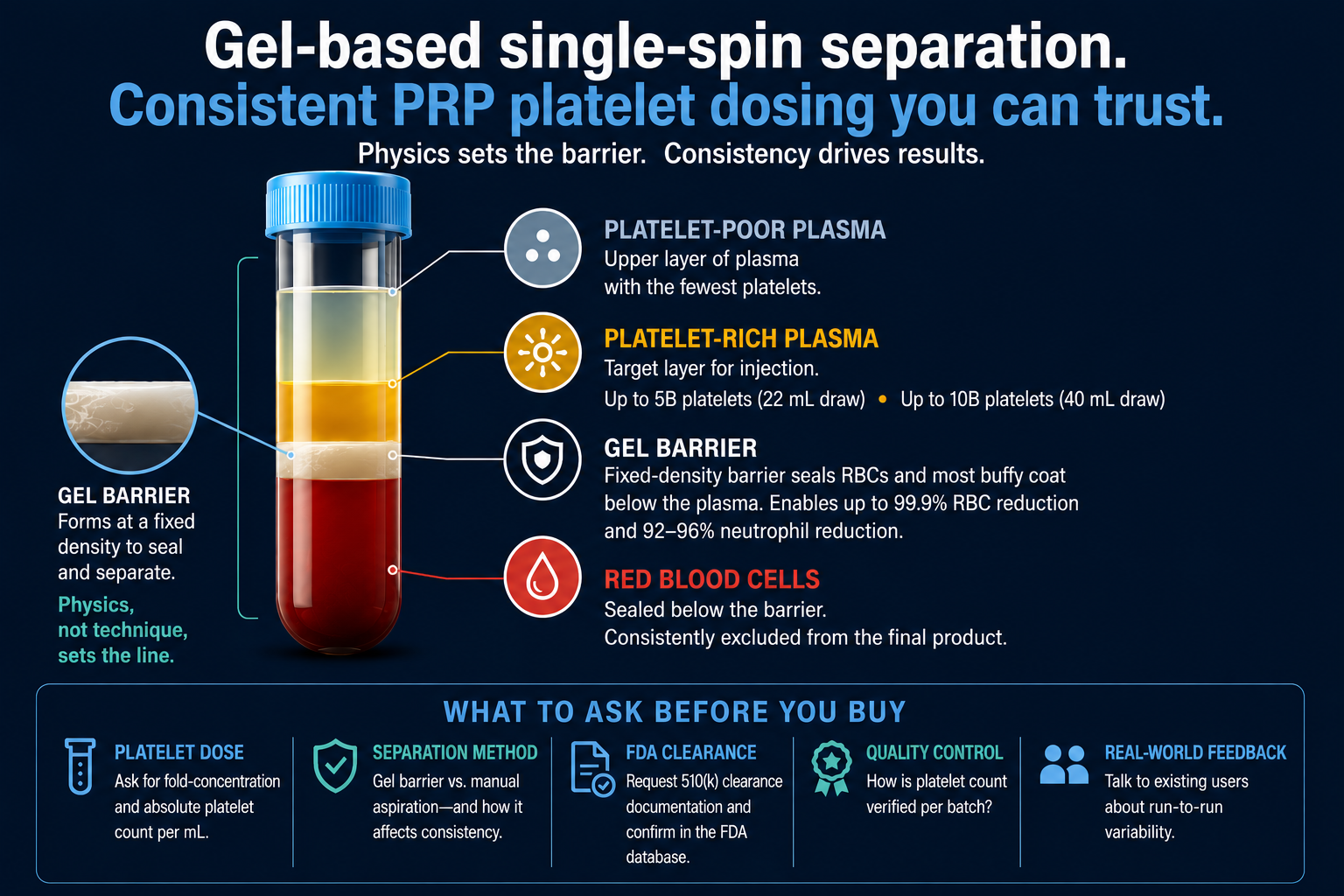
If a vendor can’t produce these numbers with a citation, note that before you sign a purchase order. Tropocells publishes draw-volume-specific yields for reference. A 22 mL draw yields up to 5 billion platelets. A 40 mL draw yields up to 10 billion. The single-spin process takes under 15 minutes from draw to ready.
Why Separation Method Is the Other Half of the Equation
Consistent PRP platelet dosing depends on more than the platelet count on a spec sheet. The separation method itself determines how reproducible your leukocyte and red blood cell content stays, patient to patient. This is where gel-based separation earns a closer look. During centrifugation, a mechanical gel barrier forms at a fixed density. It physically seals red blood cells and most of the buffy coat below the plasma layer you draw off. Physics sets the barrier position, not operator technique. That’s why it reduces the variability that comes from manual pipetting or eyeballing a plasma line.
Systems without a gel barrier ask the operator to manually estimate where to draw off plasma. Consequently, that introduces run-to-run variability, especially across less experienced staff or busier clinic days. A fixed gel interface removes that judgment call from the workflow.
In short, separation consistency depends on the mechanism, not just the spin speed. A physical, repeatable barrier lowers the odds that a provider gets a different preparation on a Tuesday than on a Friday.
Tropocells uses a gel-based, single-spin design built around this principle. The gel barrier supports up to 99.9% RBC reduction and 92–96% neutrophil reduction, independent of any single operator’s draw technique. It also supports greater than 86.2% monocyte retention, with roughly 80% platelet yield in a single four-step workflow. That combination is part of why PRP platelet dosing stays predictable draw after draw.
What Retrospective Clinical Data Can — and Can’t — Tell You
Larger retrospective datasets help you understand real-world consistency across a broad patient population. A small prospective trial tells you something different: how a single protocol performed. Neither one substitutes for a vendor’s own PRP platelet dosing data. When you review a manufacturer’s clinical evidence packet, look for:
- Sample size, and whether it reflects your target patient population
- Whether the vendor actually measured and reported platelet counts and separation performance, rather than assuming them
- Whether independent reviewers verified the data, or only the manufacturer produced it
For example, a 2023 peer-reviewed narrative review in Biomedicines offers one useful independent reference point: “Angiogenesis and Tissue Repair Depend on Platelet Dosing and Bioformulation Strategies Following Orthobiological Platelet-Rich Plasma Procedures.” It helps you separate published, peer-reviewed evidence from manufacturer-only claims. Retrospective data is a reasonable starting point for evaluating consistency at scale. But it should complement a system’s published technical specifications, not replace them.
A Practical Checklist Before You Buy
Use this list to pressure-test any vendor’s PRP platelet dosing claim before you commit to a system:
- Get the fold-concentration range, and confirm the vendor tested it across multiple draw volumes, not a single ideal sample.
- Ask how the system separates components: gel barrier, manual aspiration, or another mechanism, and how each affects run-to-run consistency.
- Request the device’s FDA classification and clearance documentation directly. Don’t rely on a sales deck. You can look up any device’s clearance status directly in the FDA 510(k) database. Tropocells holds FDA 510(k) clearance and ships through McKesson.
- Confirm what quality control step, if any, verifies platelet count per batch, rather than assuming consistency from the kit design alone.
- Talk to at least one existing customer about run-to-run variability they’ve observed in their own practice.
The Bottom Line on PRP Platelet Dosing
“PRP” is not a specification. Platelet dose and separation method are. A system that can tell you both, with data behind it, gives your clinic a defensible, repeatable protocol. Gel-based, single-spin systems like Tropocells answer both questions directly. They state a platelet dose per draw volume. And their physical separation barrier doesn’t rely on operator judgment to hit it. A system that can’t answer both is asking you to take its marketing on faith.
Want to see how Tropocells’ platelet dosing and separation data compares to what you’re running today? Reach out to our team, or browse more clinical and technical breakdowns on the Transcend Biologics PRP technology blog.
We provide this content for general educational and informational purposes for healthcare business and clinical decision-makers. It does not diagnose, treat, cure, or prevent any disease or condition, and it does not constitute medical advice. Applicable FDA frameworks regulate platelet-rich plasma products, including 21 CFR Part 1271 for human cellular and tissue-based products and applicable device regulations for separation systems. Clearance status and intended use vary by product, so confirm them against the specific device’s FDA clearance and Instructions for Use (IFU). Clinical outcomes vary by patient, protocol, and provider. This post does not claim FDA approval or clearance of any specific indication. Review a device’s official labeling or consult regulatory counsel instead of relying on this post as a substitute.